



Heavy-duty truck-mounted crane applications are suited to lifting scenarios that require a stronger vehicle platform, a larger working envelope or more demanding site logistics than a light delivery crane. The category can support industrial handling, construction supply, infrastructure work and equipment placement, but the correct configuration is always determined by the load chart and the planned lift.
The image shows a truck-mounted crane in a vehicle yard and is used to illustrate the application category. It does not establish a specific lifting capacity, boom length or certification. Buyers should use the image as a visual reference and request the exact model data for their intended operation.
Selection rule: describe the actual load, radius, height, ground and access conditions before comparing heavy-duty crane configurations.
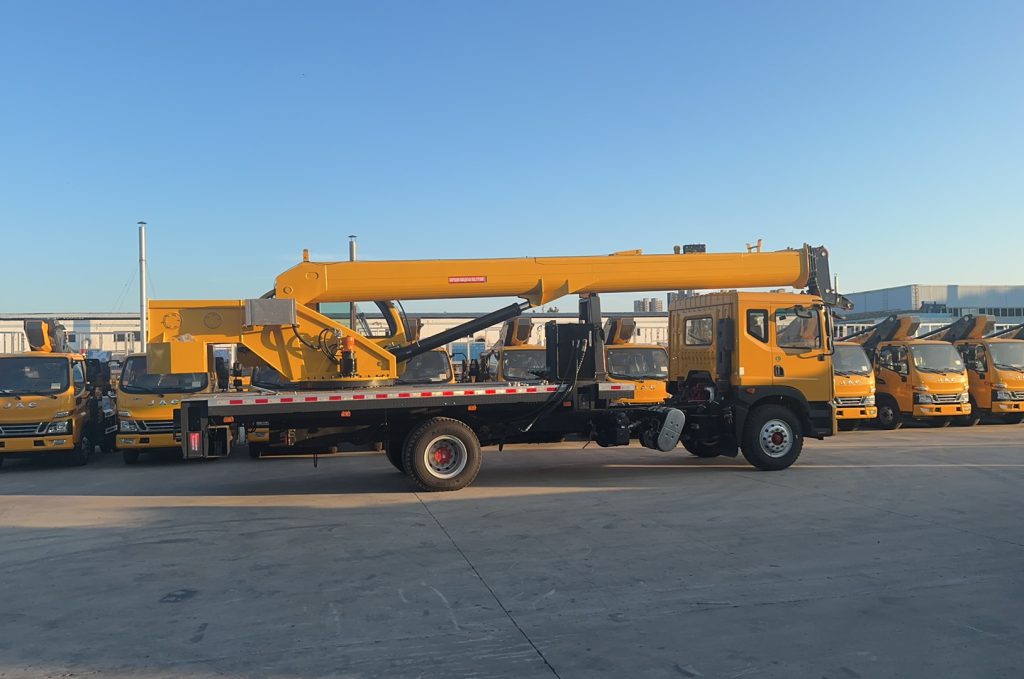
Where Heavy-Duty Truck-Mounted Cranes Add Value
Industrial Equipment Placement
Industrial sites often need to move motors, fabricated assemblies, tanks, tools or maintenance equipment from a transport vehicle to a prepared position. A heavy-duty truck-mounted crane can combine transport and placement, reducing the number of separate vehicle movements. The lift still needs an engineered sequence, suitable accessories and a landing area that can receive the load.
Construction Supply and Structural Work
Large construction components may need to be delivered close to the installation point and placed within a controlled work zone. Consider the route, site access, ground conditions, overhead obstructions and the space needed to deploy supports. HSE’s lifting-operation planning guidance is a useful general reference for competent planning; local regulations and the manufacturer’s instructions control the actual operation.
Infrastructure and Utility Projects
Bridge, road, utility and maintenance work may require lifting over a longer radius or in a restricted traffic environment. The buyer should provide a site sketch, the load path and any road-control requirements. This allows the vehicle and crane arrangement to be assessed as a complete system rather than by boom length alone.
Heavy-Duty Crane Specification Checklist
- Maximum and typical loads, including slings, hooks and attachments.
- Working radius, lift height and the required placement direction.
- Support surface, outrigger spread, slope and ground-bearing information.
- Vehicle axle, transport, road-registration and destination-market requirements.
- Operator competence, inspection records, manuals and requested handover documents.
Compare the Complete Working Envelope
Crane performance is not represented by a single number. Ask for the chart covering the proposed boom position and radius, then confirm how the truck, body, outriggers and accessories affect the configuration. Our truck-mounted crane product category can help you identify the relevant model discussion.
Frequently Asked Questions
Is a heavy-duty crane suitable for every industrial lift?
No. Suitability depends on the actual load, radius, support conditions, route and site risks. A heavy-duty label does not remove the need for a lift plan or confirm that a particular configuration can complete the job. Request model-specific technical information and competent review.
What should be included in a first enquiry?
Include the load dimensions and weight, working radius and height, site photographs or a sketch, setup constraints, destination and requested documents. If any value is estimated, label it clearly. This gives the supplier enough context to discuss a suitable configuration without treating assumptions as final specifications.
Prepare the Next Project Discussion
Heavy-duty truck-mounted crane applications should be planned around the real work point, not a brochure headline. Send a concise lifting brief to TRODAT, review the relevant model data and confirm the final vehicle, crane, documents and operating responsibilities in writing.